



Brazilian Benefits Market – Transformation, Challenges, and Opportunities
The benefits sector in Brazil is estimated at around BRL 180 billion (2025), with an expected average annual growth of 9.5% over the coming years (2025–2029).
This market is undergoing one of the most significant structural transformations in its history.
For many years, operating under a closed model dominated by a few players, the market is now evolving through a new dynamic, driven by regulatory changes, the entry of new competitors, the emergence of open models, accelerated digitalization, and new user expectations and demands.
We are facing a more complex, more competitive environment — one that can offer significant opportunities for those players who plan appropriately.
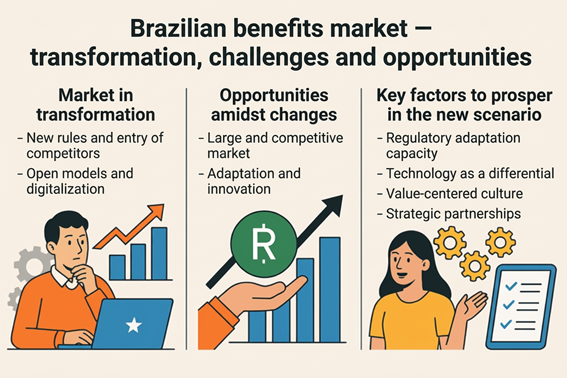
1- Market in Transformation
The recent revision of the PAT (Employee Meal Program) rules, the end of the closed-model requirement, the rise of fintechs and HR Techs, and the advancement of the Open Benefits agenda are just some of the elements reshaping the sector.
These changes are opening space for new entrants and innovative models, while at the same time challenging incumbents to rethink their strategies. Competitiveness has increased, along with the demand for genuine differentiation.
2 – Opportunities Amidst Change
Despite (or because of) the turbulence, the market remains vast. We are talking about millions of workers served, billions of reais in annual transactions, and an increasing importance in companies’ talent attraction and retention strategies.
Those who manage to adapt to the new rules of the game will find fertile ground for growth. But it is not enough to merely react to changes — one must anticipate them, influence them, and innovate consistently.
3 – Key Factors to Thrive in the New Scenario
In a scenario like this, what are the critical success factors?
Regulatory adaptation capability: understanding and operating according to changes in the PAT and taxation, turning compliance into a competitive advantage.
Technology as a differentiator: a digital platform integrating systems, data, and functionalities – scaling personalized use. It is increasingly important to build flexible and modular systems that scale as the business grows.
Culture focused on real value for HR and employees: providing a smooth digital experience, clear dashboards, and flexible budget management. In this context, it is important to define journeys where HR can measure the impact and payback of each benefit.
Sustainable business model: balancing investment in customer acquisition with retention and average ticket. It is increasingly important to understand and measure unit economics, considering churn, CAC, and upsell.
-
Strategic ecosystem partnerships: connecting players/solutions in health, food, finance, mobility, and culture through APIs and agreements. In this context, it is important to design these alliances in a way that expands the portfolio without inflating CAPEX or creating complexity that is difficult to manage.
Speed and culture of innovation through experimentation: testing hypotheses with MVPs, collecting feedback, and iterating quickly. The structure and mindset of internal teams must be prepared for this new dynamic.
The Brazilian benefits market is far from defined. In fact, it is being reinvented at this very moment. Those who can combine strategic vision, agile execution, and a genuine focus on customer needs will be in a privileged position to lead the next era of the sector.

Marcio Nieble
Global executive, more than 25 years of experience in business leadership, growth strategies, building teams, managing P&L and delivering solid results.