



Distribution Logistics Optimization – Efficiency as a Competitive Differentiator
The main challenges of Distribution Logistics include:
Complex route management: the need to select efficient paths that avoid congestion, reduce distances, and, in remote areas, also evaluate the quality of infrastructure.
Definition of the operating model: analyses of direct operations (own fleet and resources) vs hiring logistics operators vs spot contracts. Beyond capital costs, operational costs must be modeled, such as fuel, fleet maintenance, salaries, and labor charges, among others. In addition to economic variables, it is important to consider management and customer satisfaction aspects.
Warehousing: defining the necessary structures for inventory (warehouses, cross-docking) considering locations, costs, characteristics, etc.
Management technology: defining management systems, with integration between commercial and financial activities.
Optimization Strategies
To tackle these challenges, some key actions are essential. The main point is to have a deep understanding of your business, the loads to be transported, origins and destinations, customer characteristics and demands, possible routes, and commercial and economic-financial objectives.
From this knowledge, it is possible to model the costs involved in the operation, using the current scenario as a starting point.
This allows potential improvements and optimizations to be estimated in terms of their impact within the logistics operation context.
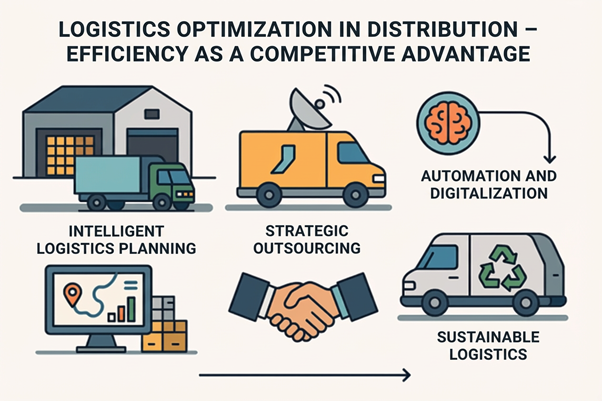
There are several dimensions to work on, such as:
1 – Intelligent Logistics Planning
- Use of logistics management software (TMS and WMS) for automated routing and inventory control.
- Demand forecasting based on historical analyses, market data, current market share, and target objectives.
2 – Automation and Digitalization
- Tracking systems and sensors in vehicles for continuous monitoring.
- Integration with artificial intelligence for dynamic decision-making.
3 – Strategic Outsourcing
- Use of specialized logistics operators providing state-of-the-art infrastructure and technology.
- Partnerships that ensure scalability and better service in specific geographic areas.
4 – Sustainable Logistics
- Optimized routes to reduce greenhouse gas emissions.
- Use of reusable packaging and transportation with electric vehicles.
Logistical success does not depend solely on investment in infrastructure, but above all on operational intelligence. Optimizing distribution logistics requires alignment between technology, people, and processes. Companies that master this art gain significant competitive advantage and achieve relevant differentiators for their clients and markets.

Frederico Barbosa
Co-founder/Sr. Partner at BFG Consult Engenheiro pela UFMG, com MBA pelo INSEAD (França). Vasta experiência em consultoria de gestão, com atuação de sucesso em múltiplos setores e geografias. Ajudo empresas a superar desafios e alcançar resultados tangíveis, impulsionando o crescimento de receitas, melhorando a performance comercial e financeira, viabilizando a expansão para novos mercados/ofertas e otimizando a satisfação do cliente.